By Regina Bortoni
I knew I would be planning a step-free route to travel across the city. I prepared ahead of time and assumed it would be a straightforward process. I trusted the Tube map to show which stations were step-free, and I didn’t realise how different fully step-free and semi–step-free stations could be in practice. As a non-disabled passenger, I hadn’t considered how many variables affect accessible travel or how easily things can go wrong. I began the journey confident I was ready, but I learned very quickly that it wasn’t as simple as I thought.
I met Tracey, co-founder of Proudlock Associates, at King’s Cross Station, and from there it was up to me to guide us along the step-free route. It was only at that point that I realised Oxford Circus is not step-free, which meant rethinking the journey entirely.
We asked Underground staff for advice. They were helpful, but the route they suggested wasn’t step-free in practice. One of their recommended stations had a lift that had been out of service for weeks, something Tracey already knew but the staff didn’t. Their alternative involved switching lines and getting off at Moorgate, which they assured us was step-free. Once on the Tube, we discovered it wasn’t.
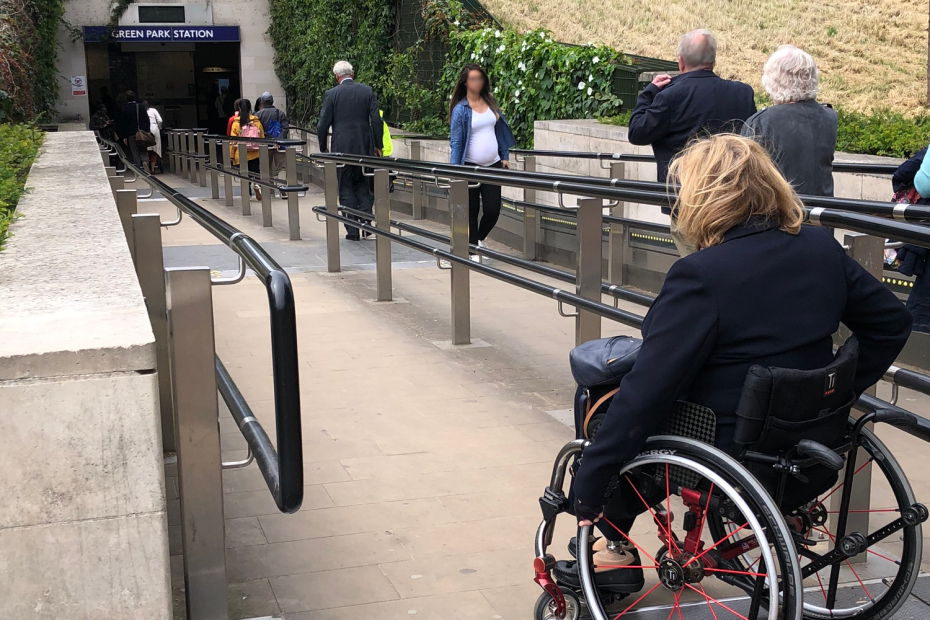
We stayed on the train until the next confirmed step-free station: London Bridge. Even there, it wasn’t straightforward. The lift wasn’t inside the station, there were no signs pointing to it, and several staff weren’t sure where it was. We spent nearly half an hour circling the area before finally finding it.
What surprised me most wasn’t the lack of information or the broken lifts, although both are significant barriers. What stood out was how normal all of this felt to Tracey. She navigated the situation with complete familiarity, as if these obstacles were simply part of everyday travel. That, to me, was the biggest insight: the system has so many predictable barriers that disabled people learn to adapt as if this were the standard.
What this journey highlighted for me
- Staff often lack up-to-date information about lift outages and step-free status.
- “Step-free” and “semi–step-free” labels can be misleading and don’t reflect real usability for all wheelchair types.
- Signage for lifts, especially street-level ones, is inconsistent or completely absent.
- When a lift is out of service, alternative routes are limited and can significantly prolong the journey.
- Real-time, reliable accessibility information is essential for disabled people to travel independently and efficiently.
This experience gave me a small glimpse into the realities of step-free travel in London, not just the technical barriers but also the constant need to problem-solve around them. It reinforced how much planning, awareness, and adaptability disabled people need for what should be a simple journey. Although this experience was with a wheelchair user, other people (such as older adults and blind or partially sighted travellers) also rely on step-free environments and functioning lifts to move safely through the city. There is progress, but there is still a long way to go before step-free travel feels truly seamless.